
Has your nose been blocked for weeks, with a heaviness in your head, and that cold you thought would “pass” still has not? Many people wait for weeks, assuming it is a simple cold. But the scientific data show that a very different picture may lie behind symptoms lasting more than 12 weeks.
In this article you will learn, in the light of medical research, where the fine line between a cold and chronic sinusitis lies.
1. The timeline: how long have you been blocked?
The biggest difference between a cold and sinusitis is the calendar. If you look at how long your symptoms have lasted, you will largely find the answer.
- An ordinary cold: usually lasts 7–10 days, and you are fully recovered within 3 weeks at the latest.
- Chronic rhinosinusitis (CRS): clinical research defines symptoms lasting 12 weeks or longer as “chronic”. If you have not felt fully clear for 3 months, this may no longer be about a virus.
2. Comparing the symptoms: what is your body telling you?
According to the scientific literature, these are the main symptom groups that separate chronic sinusitis from a cold:
| Feature | Common cold | Chronic sinusitis (CRS) |
|---|---|---|
| Duration | 7–10 days | 12 weeks or more |
| Nasal discharge | Clear at first, then thicker (short-lived) | Persistent postnasal drip or thick discharge |
| Loss of smell | Temporary and mild | Marked, long-lasting reduction in smell |
| Facial pain | Rare and mild | Facial pressure, toothache and a feeling of heavy pressure |
| Tiredness / sleep | Only for the first few days | Chronic fatigue and poorer sleep quality |
An important note: research stresses that chronic sinusitis is not just an infection but a process of chronic inflammation in the sinus passages.
3. “I thought it was a cold, but it didn’t go away”: why see a doctor?
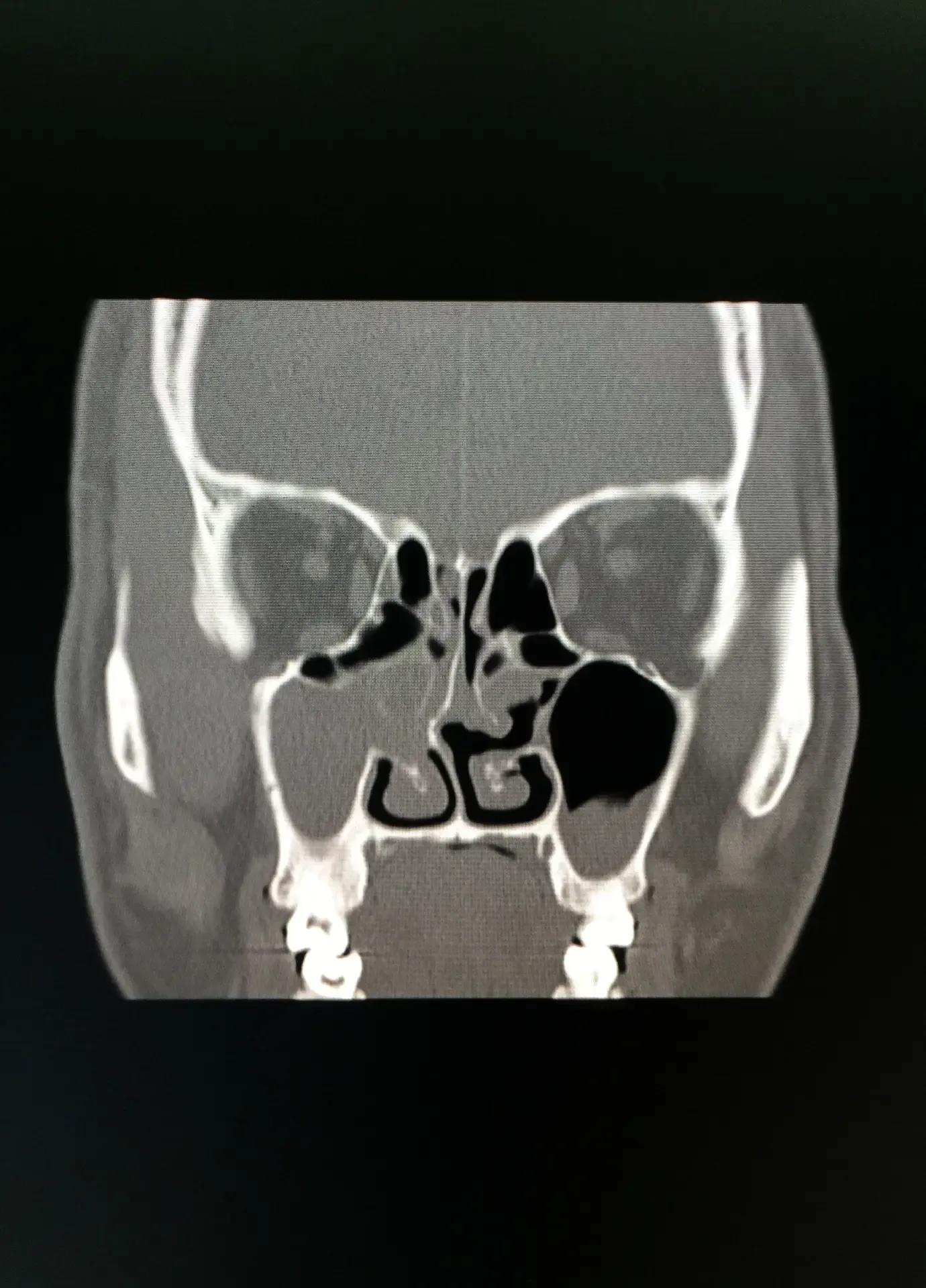
According to the medical literature, CT scans taken during a cold can show temporary abnormalities in the sinuses, but these resolve by themselves within 2–3 weeks.
If your symptoms have lasted more than 12 weeks, an ENT specialist makes the definite diagnosis with the following:

- Endoscopy: seeing directly any inflammation or polyps inside the nose.
- CT scan: identifying chronic blockage in the sinuses and any polyps.
4. The treatment approaches are different
The most common mistake people make is to reach for antibiotics for every blocked nose. The scientific reality is this:
- A cold is caused by a virus; antibiotics do not work. Rest and supportive treatment are enough.
- Chronic sinusitis, on the other hand, is not simply a bacterial condition but a structural problem or chronic swelling. Here treatment is aimed at reducing the inflammation.
Conclusion: what should you do?
If the blockage in your nose is accompanied by a feeling of pressure in your face and this has gone on for 3 months, waiting for it to “go away by itself” may lower your quality of life. Do not neglect these symptoms.
For a treatment plan tailored to you, consult an ENT specialist.
References
T. Puhakka et al. “Sinusitis in the common cold.” The Journal of Allergy and Clinical Immunology, 102 (1998): 403–408. https://doi.org/10.1016/s0091-6749(98)70127-7.
R. Rosenfeld et al. “Clinical Practice Guideline (Update): Adult Sinusitis.” Otolaryngology–Head and Neck Surgery, 152 (2015): S1–S39. https://doi.org/10.1177/0194599815572097.
J. Gwaltney et al. “Computed tomographic study of the common cold.” The New England Journal of Medicine, 330 1 (1994): 25–30. https://doi.org/10.1056/nejm199401063300105.
R. Rosenfeld et al. “Clinical practice guideline: Adult sinusitis.” Otolaryngology–Head and Neck Surgery, 137 (2007): S1–S31. https://doi.org/10.1016/j.otohns.2007.06.726.